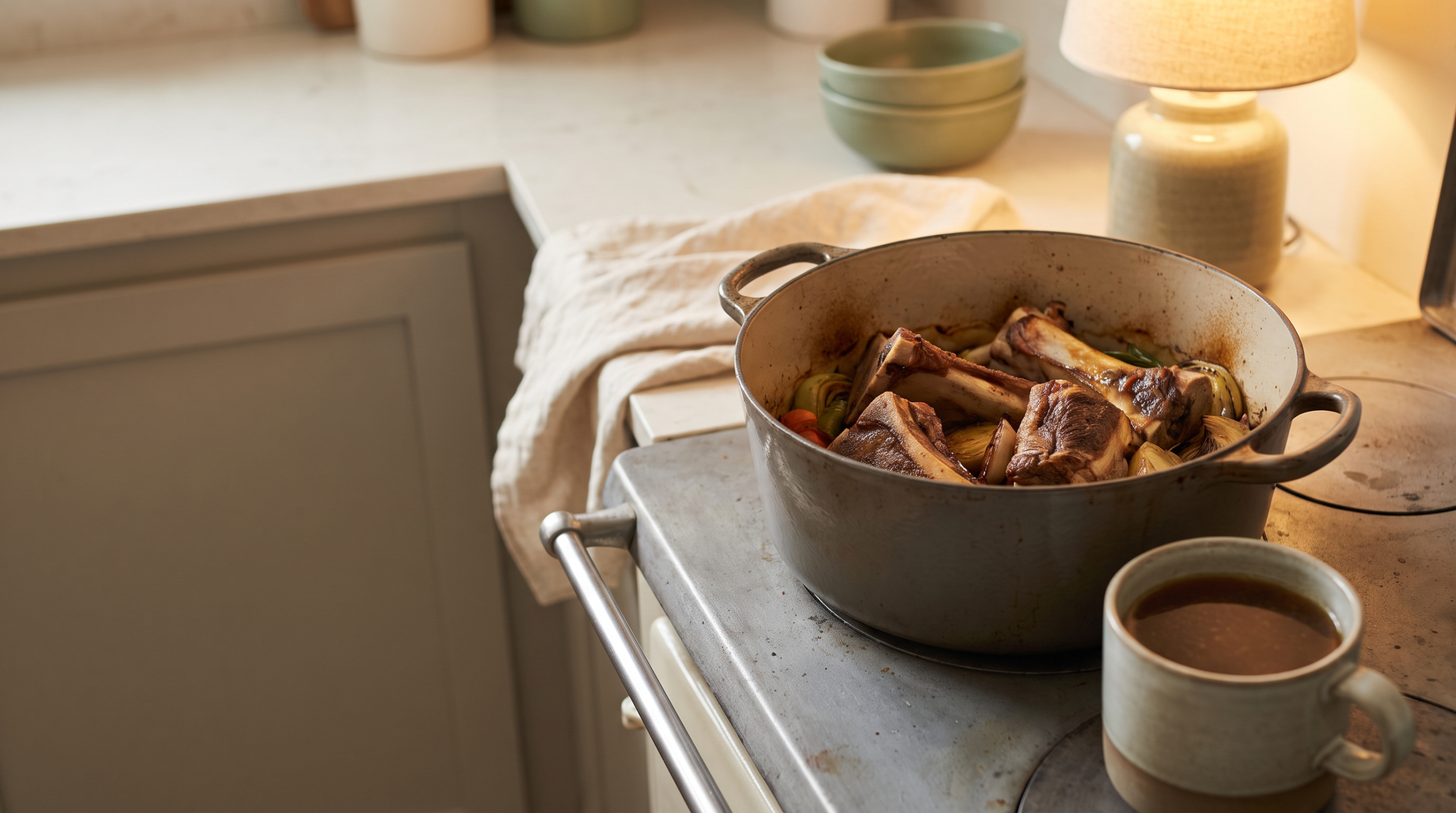
The Bare Bones of Beef Broth The quick answer
Beef bone broth is the richest and most full-bodied of the broths, with the most gelatin and protein. That makes it a favorite for sipping, for the bone broth diet, and for anyone drawn to collagen for skin and joints, with the honest caveat that broth is nourishing food, not a proven treatment.
- Richest in collagen and gelatin, so it sets into the firmest gel.
- Among the highest in protein per cup, which makes it filling.
- Studied collagen benefits for skin and joints come mostly from supplements, not broth.
- Grass-fed beef bones are the usual quality recommendation.
- Best made from roasted marrow and joint bones, simmered 12 to 24 hours.
Of all the broths, beef bone broth is the one people reach for when they want bone broth to do real work in their routine. It has the deepest color, the fullest body, and the most gelatin, which is simply dissolved collagen. Here is an honest look at what it offers, what it does not, and how to make a great pot.
Why Beef Bone Broth Is the Richest
Beef bones and joints are dense and heavy in connective tissue, so a long simmer pulls out more collagen than any other common type. That collagen becomes gelatin, which is why beef broth sets into the firmest, wobbliest gel when chilled and feels so satisfying to sip. It is also among the highest in protein per cup, a big part of why a warm mug feels like a small meal rather than just a warm drink.
Beef Bone Broth Benefits
Collagen for Skin and Joints
Because it is the most collagen-rich broth, beef is the one most associated with skin and joints. The evidence here is promising but needs an honest frame. A systematic review of 26 randomized trials found that collagen improved skin hydration and elasticity, and a meta-analysis of 35 trials found a small-to-moderate reduction in joint pain. The catch is that those trials used measured collagen supplements, while an independent analysis found that broth’s collagen is variable and usually much lower, and some of that research is industry-funded. So beef bone broth may support skin and joints as part of a steady routine, with results that build over weeks and vary from person to person.
“There’s no downside to ingesting collagen, but there’s also no clear benefit.”
Dr. Denise Millstine, integrative medicine, Mayo Clinic
Protein and Staying Full
This is beef broth’s most dependable benefit. It is among the highest in protein of any broth, and dietitians note that bone broth is an easy way to add protein to your day. A warm, savory, protein-forward cup with very few calories is genuinely satisfying, which is why beef is the workhorse of the bone broth diet and fasting-style eating.
Beef Bone Broth Nutrition
A cup of beef bone broth is low in calories, delivers a few grams of protein (mostly collagen), and carries small amounts of minerals such as calcium, magnesium, and phosphorus drawn from the bones. As with every broth, the exact numbers vary with the bones and the cook, so think of it as a nourishing contributor rather than a precisely dosed supplement. For how it compares to powders and concentrates, see forms of bone broth.
How to Make Beef Bone Broth
A good pot starts with the right bones: a mix of marrow bones for richness and joint bones such as knuckles and feet for the gelatin that makes the broth set. Roasting the bones first, at high heat until deeply browned, is the single biggest thing you can do for flavor.
From there it is patience. Cover the roasted bones with cold water, add a splash of vinegar to help draw out the minerals, and bring everything to the gentlest simmer. Beef bones reward a long cook, often twelve to twenty-four hours, so the collagen has time to break down. Skim now and then, add aromatics like onion, carrot, and bay near the end, then strain and cool. If it wobbles like jelly in the fridge, you nailed it. For ways to drink and store it, see how to use bone broth.
Sourcing and Safety
Grass-fed beef bones are the usual quality recommendation, both for flavor and peace of mind. On safety, a small 2013 study raised a question about lead leaching from bones, while a later peer-reviewed analysis found the heavy-metal risk to be minimal. Watch the sodium in store-bought versions, and if you are pregnant, nursing, or managing a condition, check with a professional. This is information, not medical advice.
Frequently Asked Questions
Is beef bone broth good for your skin?
It is a source of collagen, which research links to skin elasticity, though mostly in studies using supplements. It may support skin as part of a consistent routine. It is not an overnight fix, and results vary.
Does beef bone broth have the most collagen?
Among the common types, yes. Beef bones and joints yield the most gelatin, which is why beef bone broth sets into the firmest gel.
How long should I simmer beef bone broth?
Beef bones are dense, so most people simmer them gently for twelve to twenty-four hours. The long cook is what coaxes out the collagen.
Should I roast the bones first?
It is not required, but it makes a real difference, deepening the color and giving beef bone broth its rich, roasted flavor.
Is beef bone broth good for weight loss?
It can help as part of a plan, because it is high in protein and low in calories. It is not a magic drink, and it is not filling enough to replace a real meal.
Sources & References
Independent, third-party sources. No brand-funded or competitor-commissioned studies are cited as evidence; where cited research was industry-funded, that is noted in the text.
[1] Rahimi N, Launico MV. “Biochemistry, Collagen Synthesis.” StatPearls, NCBI Bookshelf, U.S. National Institutes of Health. www.ncbi.nlm.nih.gov/books/NBK507709/
[2] Pu SY, et al. “Oral Collagen for Skin Anti-Aging: Systematic Review and Meta-Analysis” (26 RCTs). Nutrients, 2023. www.ncbi.nlm.nih.gov/pmc/articles/PMC10180699/
[3] Collagen derivatives for osteoarthritis: trial-sequential meta-analysis (35 RCTs). Osteoarthritis and Cartilage, 2024. www.sciencedirect.com/science/article/pii/S1063458424000049
[4] Alcock RD, Shaw GC, Burke LM. “Bone Broth Unlikely to Provide Reliable Concentrations of Collagen Precursors.” Int. J. Sport Nutrition & Exercise Metabolism, 2019. doi.org/10.1123/ijsnem.2018-0139
[5] “Is bone broth good for you? Experts explain” (Dr. Denise Millstine, Mayo Clinic). TODAY. www.today.com/health/diet-fitness/is-bone-broth-good-for-you-rcna134088
[6] “Is Bone Broth Good for You?” (Lindsey Wohlford, RD). MD Anderson Cancer Center. www.mdanderson.org/cancerwise/is-bone-broth-good-for-you.h00-159694389.html
[7] Monro JA, et al. “The risk of lead contamination in bone broth diets.” Medical Hypotheses, 2013. www.sciencedirect.com/science/article/abs/pii/S0306987713000133
[8] Hsu D, et al. “Essential and toxic metals in animal bone broths.” U.S. National Library of Medicine (PMC5533136). www.ncbi.nlm.nih.gov/pmc/articles/PMC5533136