
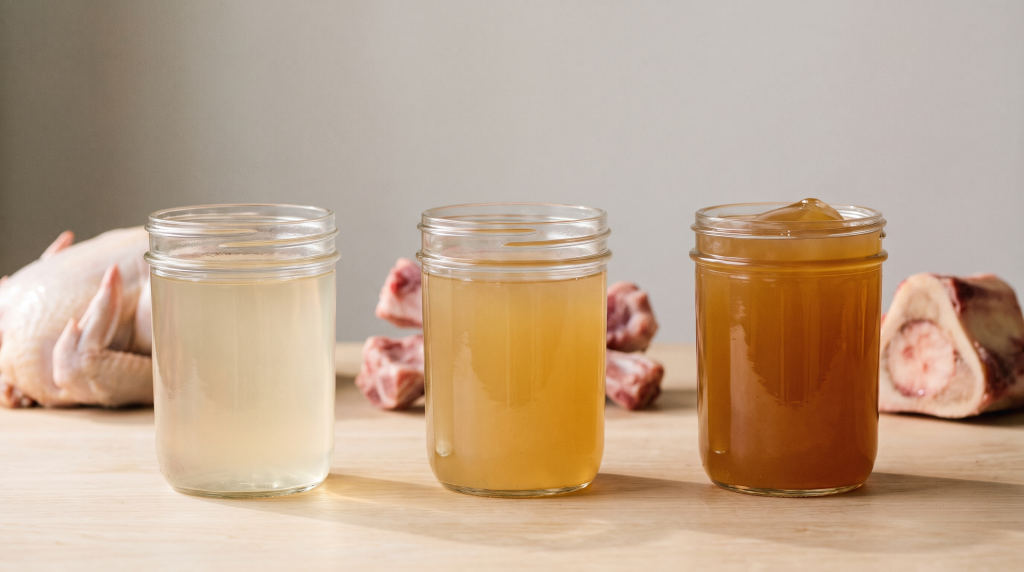
Quick answer
- Broth is meat and vegetables simmered briefly into a thin, seasoned liquid.
- Stock is bones simmered longer for more body, used as an unseasoned cooking base.
- Bone broth simmers bones and joints far longer, pulling out collagen so it gels when chilled and can be sipped on its own.
- The simplest test: if it sets into a soft jelly in the fridge, it is bone broth.
Broth, stock, and bone broth get used interchangeably on menus and labels, but they are not quite the same thing. The differences come down to what goes in the pot and how long it simmers, and that changes both how they taste and how you use them. Once you understand the three, you will know exactly which one a recipe needs and which one is worth sipping.
The confusion is understandable, because the categories overlap and brands are not always precise with their labels. Still, there is a clear logic underneath, and it mostly comes down to time and bones.
The short version
| Made from | Simmer time | Body | Typical use | |
| Broth | Meat and vegetables | Under 2 hours | Thin | A light, seasoned soup or sipping liquid |
| Stock | Bones, some meat | 3 to 6 hours | Medium | An unseasoned cooking base |
| Bone broth | Bones and joints | 12 to 48 hours | Rich, gels when cold | A collagen-rich sip or rich base |
What is broth?
Broth is the lightest of the three. It is made by simmering meat, often with vegetables and aromatics, for a relatively short time, which produces a thin, flavorful, already-seasoned liquid. Because it is not cooked long enough to draw much from the bones, broth has little body and stays liquid even when chilled.
That lightness is exactly what makes broth useful. It is ready quickly, it tastes clean, and it is the base of a simple bowl of soup or a quick poaching liquid. What it is not is a concentrated source of collagen, since the short cook time never gets the bones to give up much gelatin.
What is stock?
Stock steps things up by using bones, sometimes with a little meat still attached, and simmering them longer. That extra time pulls more gelatin from the bones, so stock has noticeably more body than broth and a richer mouthfeel. A well-made stock may even gel slightly when cold, hinting at the collagen it contains.
Stock is usually left unseasoned because it is meant to be a building block rather than a finished product. Cooks reach for it to give sauces, risottos, braises, and soups a savory backbone they can then season to taste. In that sense, stock is the workhorse of the kitchen.
What is bone broth?
Bone broth takes stock to its natural conclusion. Bones and collagen-rich joints are simmered far longer, often a full day, until plenty of collagen dissolves into the liquid as gelatin. That is what gives bone broth its silky body, its higher protein, and its signature wobble when chilled.
The other difference is intent. Unlike stock, bone broth is frequently sipped on its own, seasoned simply, the way you might drink tea. It is treated as much as a nourishing beverage as a cooking ingredient, which is why it is sold in mugs-worth cartons and powders. For more, see our guide to what bone broth is .
How they compare nutritionally
The longer a liquid simmers with bones, the more collagen and protein it tends to carry, which is why bone broth generally leads the three on both. Broth is the lightest, with the least body and the least protein. Stock sits in the middle. Bone broth, with its long extraction, offers the most gelatin and the most of the amino acids people associate with collagen.
That said, all three are low in calories and can be part of a healthy diet, and the gap is not dramatic enough to make broth or stock unhealthy. The bigger nutritional variable across all of them is sodium, which depends entirely on how much salt was added, so the label is always worth a glance.
Taste and texture
You can often tell the three apart by feel alone. Broth is thin and clean on the tongue, with an upfront seasoned flavor. Stock is rounder and more neutral, built to carry other flavors. Bone broth is the richest, with a silky, almost velvety texture that coats the mouth, a direct result of its gelatin. When warm it pours like any liquid; when cold it firms up.
Which should you use?
- For sipping, reach for bone broth. Its body and protein make it satisfying on its own, and it is the one designed to be enjoyed like a drink.
- For everyday cooking, stock is the classic neutral base, though bone broth works too and adds extra richness and body.
- For a quick, light soup, a seasoned broth is ready fastest and keeps things delicate.
- For braises and sauces, stock or bone broth both shine, since their body helps a sauce cling and a braise turn glossy.
Can you substitute one for another?
Yes, with small adjustments. Bone broth can stand in anywhere a recipe calls for stock, adding more body and flavor; just watch the seasoning, since some bone broths are salted. Stock can replace broth in most cooked dishes, though you may want to season a little more. Going the other way, broth can fill in for stock in a pinch, but the result will be lighter. The one thing broth and stock cannot fully replicate is the collagen-rich, sippable quality of a true bone broth.
A little history
The line between these three is partly culinary tradition and partly modern marketing. Cooks have simmered bones for stock for centuries, and what we now call bone broth is essentially a very long-cooked, sippable stock that older cuisines have always made, from a slow-simmered Asian bone soup to a European pot kept going for the better part of a day. The term bone broth became popular more recently, as people began drinking it for wellness rather than only cooking with it. So while the name feels new, the food is old. Understanding that history helps cut through the hype: bone broth is not a novel invention, just a traditional preparation that has found a fresh audience and a place on store shelves.
How to choose at the store
Shopping for any of the three rewards a quick label check. For a true bone broth, look for a real protein figure per serving, ideally several grams, and a short ingredient list built around well-sourced bones such as grass-fed beef or pasture-raised poultry. A broth that gels when cold is a good sign of collagen. For stock and broth, you are mainly choosing a cooking base, so flavor and sodium matter most. Across all three, watch the salt, since some products are heavily salted and others barely at all, and lower-sodium options give you more control if you cook with them often or sip them daily. If a label is vague about how the product is made, that vagueness is itself a useful signal.
Common mistakes to avoid
A few easy slip-ups can throw off a recipe. Using a salted bone broth where a recipe expects unsalted stock can leave a dish too salty, so taste and adjust as you go. Boiling a delicate broth hard can turn it cloudy and dull its flavor, so a gentle simmer is kinder. And reaching for thin broth when a dish needs the body of a stock or bone broth can leave a sauce watery and a braise lean. The fix for all of these is simple: know which of the three you have, match it to the job, and season at the end rather than the start. Get that right and the difference between broth, stock, and bone broth becomes a tool rather than a trap.
One last point worth remembering: none of the three is better than the others in the abstract. Broth, stock, and bone broth are simply different tools, each suited to a particular job, and a well-stocked kitchen often keeps more than one on hand. Once you can tell them apart by how long they simmer and whether they gel, choosing the right one becomes second nature.
Frequently asked questions
Is bone broth just stock?
Not exactly. Bone broth is essentially a longer-simmered, collagen-rich relative of stock that is also meant to be sipped. Stock is cooked for less time and used mainly as an unseasoned cooking base.
Can I use bone broth in place of stock?
Yes. Bone broth works anywhere a recipe calls for stock, and it adds more body and flavor. Just watch the seasoning, since some bone broths are salted.
Is bone broth healthier than stock?
Bone broth generally has more collagen and protein because it simmers longer, but both are nutritious. The bigger differences are body, flavor, and how you use them.
Why does my bone broth turn to jelly in the fridge?
That gel is dissolved collagen, now set as gelatin. It is a good sign that the broth is rich and collagen-heavy, and it melts right back to liquid when warmed.
Is store-bought broth the same as homemade?
The categories are the same, but quality varies. Check the label for how it is made, the protein number, and the sodium, which differ a lot between products.
